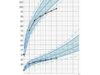
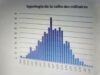
Les enfants ne répondent pas de la même façon à une dose fixe de GH prescrite par kg de poids [1]. Des endocrinologues des Pays-Bas [2] ont étudié rétrospectivement la première année du traitement :
- chez 171 enfants RCIU mesurant en moyenne -3,2 DS au début du traitement vers 7,5 ans ;
- chez 122 enfants GHD mesurant en moyenne -3,2 DS au début du traitement vers 6,7 ans.
La croissance dans la première année est connue pour prédire le gain de taille dans les années ultérieures et la taille adulte à la sortie du traitement [3-11].
Les enfants RCIU ont reçu une petite dose de 38 μg/kg.jour, loin de celle jugée optimale par des études antérieures [12-14]. Les enfants GHD ont reçu une dose encore plus petite de 27 μg/kg.jour, comparée à celle jugée optimale par des études antérieures [15]. Les « mauvais répondeurs » ayant été définis comme les mauvais répondeurs à ces doses-là, les résultats doivent être relativisés
Un gain de taille <0,5 SD dans l’année a identifié 37% de mauvais répondeurs aux petites doses données chez les enfants RCIU, et 26% chez les enfants GHD.
Des pourcentages voisins de mauvais répondeurs ont été trouvés chez 173 GHD et 54 RCIU des pays nordiques [16].
Comment régler le problème des mauvais répondeurs à l’hormone de croissance ? Il n’y a aucune raison de penser que les individus ont la même sensibilité aux médicaments ou aux hormones qu’ils prennent. Des facteurs génétiques et épigénétiques contribuant à la variation des réponses individuelles ont déjà été identifiés [17-20]. D’autres suivront sans doute.
Restons simple [21] : la gestion pratique des réponses insuffisantes devrait obéir à un principe pragmatique : ajuster la posologie du traitement aux effets observés chez les patients traités. Garder de petites doses si elles sont efficaces, mais savoir les augmenter en cas d’inefficacité en gardant un œil sur le dosage d’IGF1. Personnaliser le traitement permettrait de rompre avec des décennies de posologie calculée par kg de poids et offrirait au traitement par la GH la souplesse requise par l’individualité des réponses.
Références
- Straetemans S, Thomas M, Craen M, et al. Poor growth response during the first year of growth hormone treatment in short prepubertal children with growth hormone deficiency and born small for gestational age: a comparison of different criteria. Int J Pediatr Endocrinol 2018; 2018:9.
- Lundberg E. Growth hormone responsiveness in children: results from Swedish multicenter clinical trials of growth hormone treatment 2017. Thèse de Doctorat. Université de Umeå.
- Straetemans S, Thomas M, Craen M, et al. Poor growth response during the first year of growth hormone treatment in short prepubertal children with growth hormone deficiency and born small for gestational age: a comparison of different criteria. Int J Pediatr Endocrinol 2018; 2018:9.
- August GP, Julius JR and Blethen SL. Adult height in children with growth hormone deficiency who are treated with biosynthetic growth hormone: the National Cooperative Growth Study experience. Pediatrics 1998; 102:512-6.
- Ranke MB, Lindberg A, Chatelain P, et al. Derivation and validation of a mathematical model for predicting the response to exogenous recombinant human growth hormone (GH) in prepubertal children with idiopathic GH deficiency. KIGS International Board. Kabi Pharmacia International Growth Study. J Clin Endocrinol Metab 1999; 84:1174-83.
- Thomas M, Massa G, Bourguignon JP, et al. Final height in children with idiopathic growth hormone deficiency treated with recombinant human growth hormone: the Belgian experience. Horm Res 2001; 55:88-94.
- Carel JC, Ecosse E, Nicolino M, et al. Adult height after long term treatment with recombinant growth hormone for idiopathic isolated growth hormone deficiency: observational follow up study of the French population based registry. BMJ 2002; 325:70.
- Ranke MB, Lindberg A, Albertsson-Wikland K, et al. Increased response, but lower responsiveness, to growth hormone (GH) in very young children (aged 0-3 years) with idiopathic GH Deficiency: analysis of data from KIGS. J Clin Endocrinol Metab 2005; 90:1966-71.
- Reiter EO, Price DA, Wilton P, et al. Effect of growth hormone (GH) treatment on the near-final height of 1258 patients with idiopathic GH deficiency: analysis of a large international database. J Clin Endocrinol Metab 2006; 91:2047-54.
- Cutfield W. Growth hormone treatment to final height in idiopathic growth hormone deficiency: the KIGS experience. In: Ranke MB, Price D, A., and Reiter EO, editors. Growth hormone therapy in pediatrics – 20 years of KIGS. Basel: Karger; 2007. p. 145-62.
- de Ridder MA, Stijnen T and Hokken-Koelega AC. Prediction of adult height in growth-hormone-treated children with growth hormone deficiency. J Clin Endocrinol Metab 2007; 92:925-31.
- Rachmiel M, Rota V, Atenafu E, et al. Final height in children with idiopathic growth hormone deficiency treated with a fixed dose of recombinant growth hormone. Horm Res 2007; 68:236-43.
- Czernichow P. Growth hormone treatment of short children born small for gestational age. Acta Paediatr Suppl 1997; 423:213-5.
- de Zegher F, Albertsson-Wikland K, Wollmann HA, et al. Growth hormone treatment of short children born small for gestational age: growth responses with continuous and discontinuous regimens over 6 years. J Clin Endocrinol Metab 2000; 85:2816-21.
- Van Pareren Y, Mulder P, Houdijk M, et al. Adult height after long-term, continuous growth hormone (GH) treatment in short children born small for gestational age: results of a randomized, double-blind, dose-response GH trial. J Clin Endocrinol Metab 2003; 88:3584-90.
- Cohen P, Germak J, Rogol AD, et al. Variable degree of growth hormone (GH) and insulin-like growth factor (IGF) sensitivity in children with idiopathic short stature compared with GH-deficient patients: evidence from an IGF-based dosing study of short children. J Clin Endocrinol Metab 2010; 95:2089-98.
- Bang P, Bjerknes R, Dahlgren J, et al. A comparison of different definitions of growth response in short prepubertal children treated with growth hormone. Horm Res Paediatr 2011; 75:335-45.
- Dos Santos C, Essioux L, Teinturier C, et al. A common polymorphism of the growth hormone receptor is associated with increased responsiveness to growth hormone. Nat Genet 2004; 36:720-4.
- Wassenaar MJ, Dekkers OM, Pereira AM, et al. Impact of the exon 3-deleted growth hormone (GH) receptor polymorphism on baseline height and the growth response to recombinant human GH therapy in GH-deficient (GHD) and non-GHD children with short stature: a systematic review and meta-analysis. J Clin Endocrinol Metab 2009; 94:3721-30.
- Renehan AG, Solomon M, Zwahlen M, et al. Growth hormone receptor polymorphism and growth hormone therapy response in children: a Bayesian meta-analysis. Am J Epidemiol 2012; 175:867-77.
- Ouni M, Belot MP, Castell AL, et al. The P2 promoter of the IGF1 gene is a major epigenetic locus for GH responsiveness. Pharmacogenomics J 2016; 16:102-6.
- Bougneres P. The exon-3 deletion of the growth hormone receptor (GHR) gene still has a limited impact in clinical endocrinology. J Clin Endocrinol Metab 2010; 95:56-9.